Published October 6, 2026 at 4:39 PM EDT
Global desktop 3D printer sales reached 5.2 million in 2025, with China manufacturing 94% of units, according to a study by AMPOWER and MTDG.
The global desktop 3D printing market saw significant growth in 2025, with 5.2 million units sold worldwide, according to a study by AMPOWER and the Manufacturing Technology Deployment Group. This represents a 34% increase from 3.88 million units in 2024. The market has expanded at a compound annual growth rate of 22.4% since 2020, indicating a sustained upward trend. The rise in sales reflects growing adoption across both consumer and industrial sectors, with desktop printers becoming more accessible and versatile.
Rapid Growth in Desktop 3D Printer Sales
China plays a central role in the production of desktop 3D printers, manufacturing 94% of the units sold globally in 2025. The Shenzhen region is home to four of the five largest manufacturers by unit volume, contributing to the area's reputation as a hub for rapid product development. This geographic concentration has led to a highly competitive and concentrated market. The region's manufacturing ecosystem, including materials producers and component suppliers, has enabled rapid scaling and innovation.
Despite the growth, some manufacturers face logistical challenges in managing large-scale operations. At Huafast’s facility in Shenzhen, for example, the reliance on SD cards for file transfer highlights the limitations of existing infrastructure. Wireless interference and the use of low-cost machines have created inefficiencies in the workflow, underscoring the need for better connectivity and management systems. These challenges are common in large-scale 3D printing operations where automation and digital integration are still evolving.
China's Role in Manufacturing and Market Leadership
The study also notes that the top five manufacturers account for 86% of sales, leaving limited room for smaller or international competitors. This concentration suggests that the market is dominated by a few key players, many of whom have expanded their presence through retail partnerships and brand visibility. The dominance of these companies has shaped the industry's direction and influenced the availability of products and services.
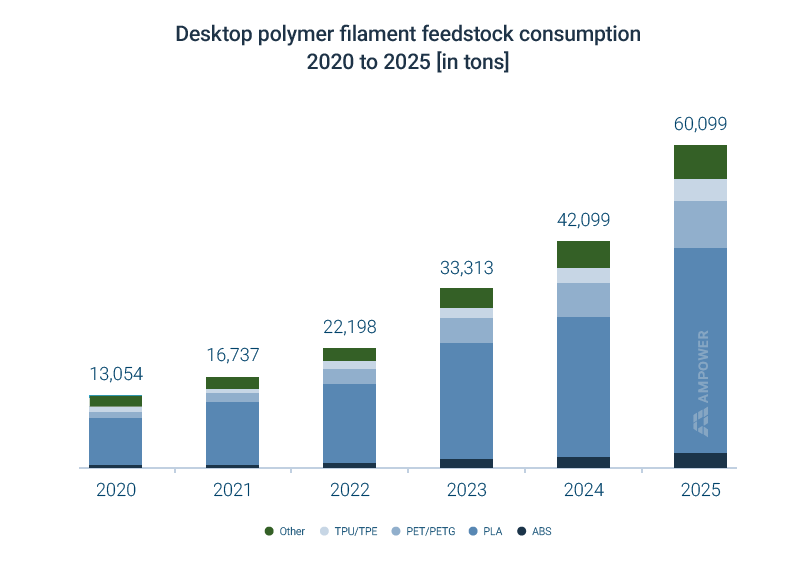
The growth in printer sales has been accompanied by a surge in filament consumption, which reached approximately 60,000 tonnes in 2025. This represents a 43% increase from the previous year. However, the rise in material usage does not necessarily indicate higher per-unit productivity, as the installed base of printers has also grown significantly. The increase in filament demand reflects the expanding use of 3D printing across various applications, from consumer goods to industrial prototyping.
AMPOWER’s research highlights the shift in how desktop 3D printing is perceived. Once considered a niche market, it is now a major segment of the additive manufacturing industry. The study suggests that the expansion of desktop printing has been driven by a consumer-electronics approach, with manufacturers aiming to sell large volumes of machines. This strategy has led to increased competition and innovation, as companies seek to differentiate themselves in a rapidly growing market.

Challenges in Managing Large-Scale 3D Printing Operations
The role of materials producers and component suppliers in Shenzhen has been critical to the region’s success. These industries have created a supply chain that supports rapid development and production, allowing manufacturers to scale quickly. This ecosystem has helped companies like Bambu Lab and Creality establish a global presence. The integration of local suppliers and manufacturers has enabled the region to maintain a competitive edge in the global market.
The study also points to the influence of retail strategies in expanding market reach. Bambu Lab, for instance, has expanded its presence in Apple stores across China, indicating a shift in how desktop 3D printers are marketed and sold. This approach aligns with the consumer-electronics model that many manufacturers have adopted. Retail partnerships have allowed companies to reach a broader audience and increase brand awareness.
The Manufacturing Technology Deployment Group (MTDG) supports the study through its work in advancing manufacturing technologies. Its role includes facilitating research and collaboration among industry stakeholders, helping to shape the direction of the desktop 3D printing market. MTDG’s efforts have contributed to the development of new standards and best practices, which are essential for the industry’s long-term growth.
Concentration of Market Share Among Top Manufacturers
The concentration of production in China has raised questions about the long-term sustainability of the market. While the region’s manufacturing capabilities are strong, the dominance of a few companies may limit diversity and innovation. This could affect the availability of alternative suppliers and the development of new technologies. The reliance on a single geographic region for production also introduces potential risks related to supply chain disruptions.
The study also highlights the challenges of integrating desktop 3D printing into industrial workflows. At Huafast, for example, the reliance on manual file transfer illustrates the gap between consumer-grade technology and the demands of large-scale production. Addressing these issues will be crucial for the continued growth of the market. Improvements in connectivity, automation, and workflow management are needed to support the increasing scale of 3D printing operations.
As the desktop 3D printing market continues to evolve, the role of infrastructure, supply chains, and business models will shape its future. The findings from AMPOWER and MTDG provide a snapshot of a rapidly growing industry, offering insights into its current state and potential trajectory. The industry’s future will depend on its ability to adapt to new challenges and opportunities, while maintaining its momentum of growth.
Log in to leave a reply. Every comment is moderated before it appears publicly.