Published October 6, 2026 at 12:13 PM EDT
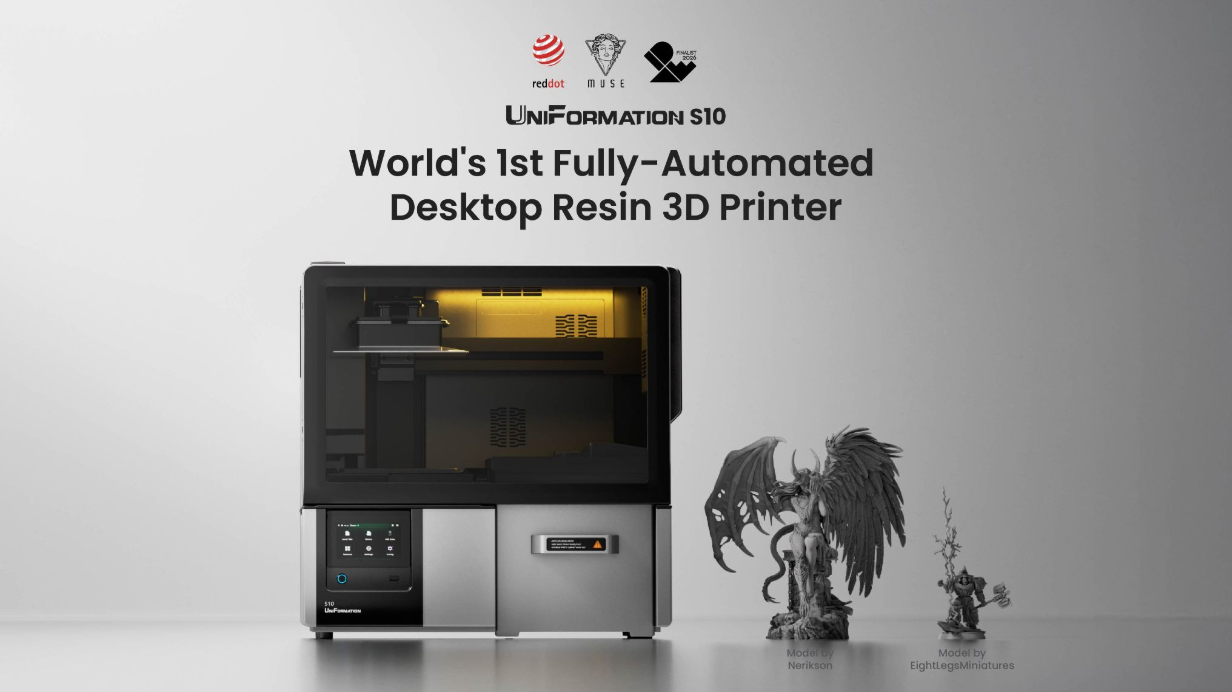
UniFormation’s S10 introduces an automated workflow for resin 3D printing, integrating printing, washing, and drying in one unit.
Automated Workflow Reduces Manual Steps
The machine is designed to significantly reduce direct resin contact during printing and post-processing, which UniFormation puts at 99% less than a conventional workflow. This could significantly lower exposure to fumes and reduce cleanup time for users. The enclosed workflow addresses something the spec sheet alone wouldn’t convey. Resin printing can produce fumes during both 3D printing and post-processing, and the more manual the workflow, the more that exposure can compound across a working day. An enclosed chamber with internal air purification is intended to help reduce odors during operation.
After printing, the build platform rotates to 180° and holds for one minute to drain excess resin back into the vat, then tilts to 90° and holds for a further two minutes to complete draining, before returning to position. A cleaning cover slides over the vat while the platform moves laterally into the wash area, where it performs a two-cycle wash, dipping into cleaning fluid and moving rapidly side to side to scrub resin off the model. After each cycle, the machine tilts on three axes to drain the cleaning fluid. After the second wash, the platform rotates 270° to align with a drying port, where a fan takes over.
Design Focuses on Safety and Efficiency
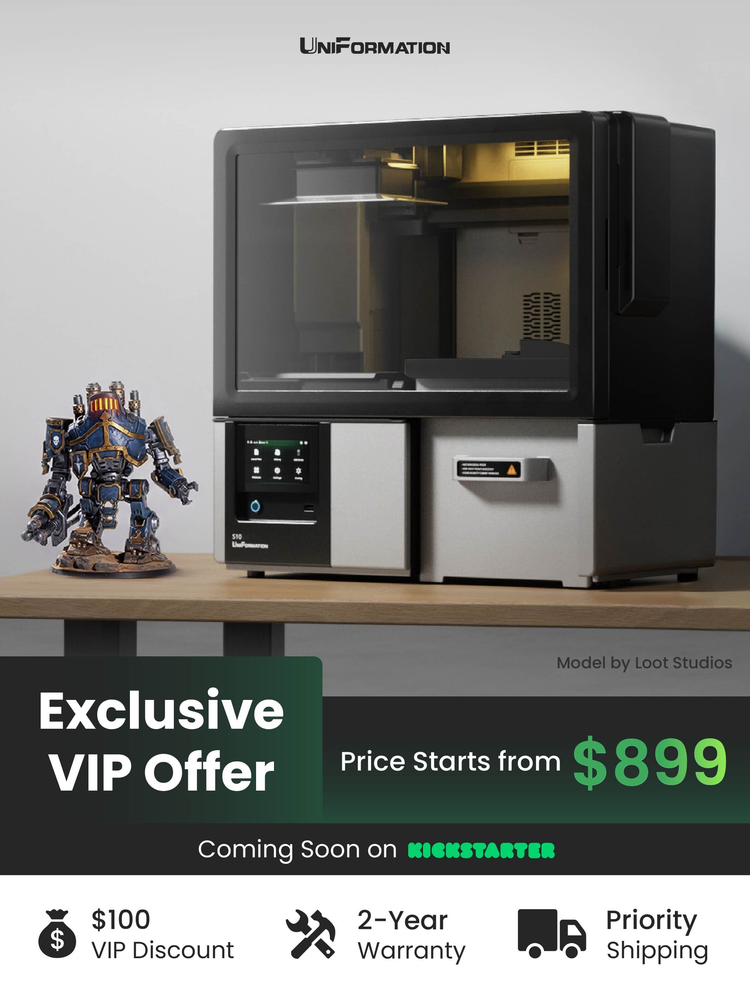
The S10 is built around a 16K mono LCD screen, 15,360 x 6,540 pixels with a pixel size of 14.52 x 19.25 μm. The Z-axis uses a C5-class ball screw with a repeatability of ±0.005 mm, and the build volume is 223.03 x 125.9 x 200 mm. The machine ships factory pre-leveled and includes pressure sensors designed to help prevent printing failures, a meaningful practical consideration for operations where wasted resin and downtime carry real costs. The S10 is set to launch on Kickstarter, where early backers can pledge at $999, with a VIP early bird price of $899. The standard retail price is set at $1,299.
The S10 features a modular design, allowing users to replace only the affected module if a component fails. This could lower long-term maintenance costs and improve the machine’s overall reliability. The machine handles printing, washing, and drying, with support removal and curing remaining as manual steps afterward. Curing requires an optional add-on module that isn’t included by default. It’s a foldable unit that snaps into the S10’s body and operates through the same touchscreen, but it’s a separate purchase.
The S10 includes pressure sensors that detect foreign objects before they cause a print failure. This feature could help prevent wasted materials and reduce the likelihood of batch losses. The machine comes with a new slicer and a model library, offering five pre-configured resin profiles. Users can select their resin type and print without adjusting parameters manually, making the process more accessible. The S10 is scheduled for an official launch in late October 2026 on Kickstarter.
Integrated Cleaning and Drying Mechanisms
UniFormation has also introduced an optional embedded curing module. This allows users to cure prints directly within the S10 without needing a separate curing machine, further simplifying the workflow. The S10 uses PTC ceramic heating to dry prints at a gentle 35–45°C (95–113°F) with controlled airflow. Gentle airflow helps keep IPA/cleaning solution from being blown toward the resin vat. PTC ceramic heating avoids exposed red-hot heating elements, helping reduce potential safety risks.
For higher-volume applications, UniFormation offers an S10 Fluid Hub that is designed to support up to three S10 units and wash two simultaneously. It runs a two-stage process, rough wash followed by a fine rinse, and the company claims it can extend wash solvent life. The efficiency gain comes from rotating fluid between the two stages: older IPA handles the initial rough wash, while cleaner IPA is reserved for the fine rinse, and once the rinse container’s fluid degrades, it cycles into the rough-wash container and is replaced with fresh IPA, stretching the useful life of each batch.
The S10’s automated workflow is intended to benefit hobbyists, prosumers, and small print farms by reducing labor and improving consistency. However, the machine’s complexity may require users to adapt to new operational procedures. The use cases UniFormation identifies span tabletop miniature production, engineering prototyping, small-batch manufacturing, and jewelry and dental model work. That last category comes with a caveat the company itself includes in its documentation.
Modular Design and Future Expansion
The mechanics of how it accomplishes this are worth understanding. After a print completes, the build platform rotates to 180° and holds for one minute to drain excess resin back into the vat, then tilts to 90° and holds for a further two minutes to complete draining, before returning to position. A cleaning cover slides over the vat while the platform moves laterally into the wash area, where it performs a two-cycle wash, dipping into cleaning fluid and moving rapidly side to side to scrub resin off the model. After each cycle, the machine tilts on three axes to drain the cleaning fluid.
UniFormation said that future product development will introduce greater flexibility to the automated post-processing workflow, allowing users to adjust draining, washing, and drying times based on the size, geometry, and specific requirements of each print. Multiple processing levels will be available to accommodate different use cases, helping ensure that models are thoroughly cleaned and sufficiently drained and dried before the build platform returns above the resin vat. This is designed to minimize the risk of residual cleaning fluid dripping back into the vat and to further improve the reliability and consistency of the automated workflow.
The S10’s automated workflow is intended to benefit hobbyists, prosumers, and small print farms by reducing labor and improving consistency. However, the machine’s complexity may require users to adapt to new operational procedures. The S10’s automated workflow is intended to benefit hobbyists, prosumers, and small print farms by reducing labor and improving consistency. However, the machine’s complexity may require users to adapt to new operational procedures.
Log in to leave a reply. Every comment is moderated before it appears publicly.